

Chinese City of Wuhan Reports Cholera Case, Communist Youth League Tries Blaming US
| Commonwealth of Red china 中華民國 | |||||||||||||||
|---|---|---|---|---|---|---|---|---|---|---|---|---|---|---|---|
| 1940–1945 | |||||||||||||||
| Flag (1940–1943) National Emblem | |||||||||||||||
| Motto:和平反共建國 "Peace, Anti-Communism, Nation building" | |||||||||||||||
| Anthem: National Anthem of the Republic of China[one] | |||||||||||||||
 The Wang Jingwei regime (dark red) and Mengjiang (light red) within the Empire of Japan (pink) at its furthest extent | |||||||||||||||
| Status | Puppet land of the Empire of Japan | ||||||||||||||
| Capital letter | Nanking | ||||||||||||||
| Largest city | Shanghai | ||||||||||||||
| Official languages | Standard mandarin Japanese | ||||||||||||||
| Government | Ane-party dictatorship | ||||||||||||||
| President | |||||||||||||||
| • 1940–1944 | Wang Jingwei | ||||||||||||||
| • 1944–1945 | Chen Gongbo | ||||||||||||||
| Vice President | |||||||||||||||
| • 1940–1945 | Zhou Fohai | ||||||||||||||
| Historical era | Earth War II | ||||||||||||||
| • Established | 30 March 1940 | ||||||||||||||
| • Recognized by Japan | twenty November 1940 | ||||||||||||||
| • Dissolved | sixteen Baronial 1945 | ||||||||||||||
| |||||||||||||||
| Today role of | Communist china | ||||||||||||||
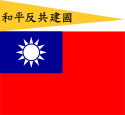


The Wang Jingwei regime is the common proper noun of the Reorganized National Government of the Republic of Cathay (Chinese: 中華民國國民政府; pinyin: Zhōnghuá Mínguó Guómín Zhèngfǔ ), the government of the puppet state of the Empire of Japan in eastern China called only the Democracy of Mainland china. This should not be confused with the contemporaneously existing National Government of the Republic of Prc under Chiang Kai-shek, which was fighting with the Allies of World War II against Japan during this period. The country was ruled as a one-political party commonwealth under Wang Jingwei, a very high-ranking old Kuomintang (KMT) official. The region that it would administer was initially seized by Japan throughout the tardily 1930s with the beginning of the Second Sino-Japanese War.
Wang, a rival of Chiang Kai-shek and member of the pro-peace faction of the KMT, defected to the Japanese side and formed a collaborationist government in occupied Nanking (Nanjing) (the traditional upper-case letter of Prc) in 1940. The new state claimed the entirety of People's republic of china during its existence, portraying itself as the legitimate inheritors of the Xinhai Revolution and Sun Yat-sen's legacy as opposed to Chiang Kai-shek's regime in Chunking (Chongqing), but effectively but Japanese-occupied territory was under its direct control. Its international recognition was limited to other members of the Anti-Comintern Pact, of which information technology was a signatory. The Reorganized National Government existed until the stop of World War 2 and the surrender of Japan in August 1945, at which point the regime was dissolved and many of its leading members were executed for treason.
The land was formed by combining the previous Reformed Authorities (1938–1940) and Provisional Authorities (1937–1940) of the Democracy of Prc, puppet regimes which ruled the fundamental and northern regions of China that were nether Japanese command, respectively. Unlike Wang Jingwei'southward authorities, these regimes were not much more than than arms of the Japanese military leadership and received no recognition fifty-fifty from Nihon itself or its allies. However, later on 1940 the former territory of the Provisional Authorities remained semi-autonomous from Nanjing'south control, nether the name "North China Political Council". The region of Mengjiang (boob regime in Inner Mongolia) was under Wang Jingwei'southward government merely nominally. His authorities was also hampered by the fact that the powers granted to information technology by the Japanese were extremely limited, and this was only partly inverse with the signing of a new treaty in 1943 which gave it more sovereignty from Japanese control. The Japanese largely viewed it as not an stop in itself simply the means to an end, a bridge for negotiations with Chiang Kai-shek, which led them to often treat Wang with indifference.
Names [edit]
The authorities is informally also known as the Nanjing Nationalist Government (Chinese: 南京國民政府; pinyin: Nánjīng Guómín Zhèngfǔ ), the Nanjing Regime, or past its leader Wang Jingwei Authorities (Chinese: 汪精衛政權; pinyin: Wāng Jīngwèi Zhèngquán ). As the regime of the Democracy of China and afterward of the People's Commonwealth of China regard the regime as illegal, it is also usually known as Wang's Puppet Regime (Chinese: 汪偽政權; pinyin: Wāng Wěi Zhèngquán ) or Puppet Nationalist Government (Chinese: 偽國民政府; pinyin: Wěi Guómín Zhèngfǔ ) in Greater Cathay. Other names used are the Republic of China-Nanjing, China-Nanjing, or New China.
Background [edit]
While Wang Jingwei was widely regarded as a favorite to inherit Sun Yat-sen's position equally leader of the Nationalist Party, based upon his true-blue service to the political party throughout the 1910s and 20s and based on his unique position every bit the i who accepted and recorded Dr. Sun's last will and attestation, he was rapidly overtaken by Chiang Kai-shek.[2] By the 1930s, Wang Jingwei had taken the position of Minister of Foreign Affairs for the Nationalist Government under Chiang Kai-shek. This put him in command over the deteriorating Sino-Japanese relationship. While Chiang Kai-shek focused his master attentions against the Chinese Communist Party, Wang Jingwei diligently toiled to preserve the peace between China and Japan, repeatedly stressing the demand for a period of extended peace in order for China to elevate itself economically and militarily to the levels of its neighbor and the other Great powers of the world.[3] Despite his efforts, Wang was unable to notice a peaceful solution to preclude the Japanese from commencing an invasion into Chinese territory.
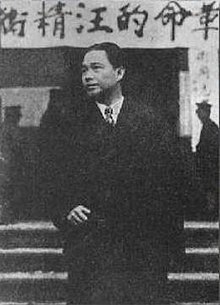
Wang Jingwei was caput of the Reorganized National Regime.
By April 1938, the national conference of the KMT, held in retreat at the temporary majuscule of Chongqing, appointed Wang as vice-president of the party, reporting merely to Chiang Kai-shek himself. Meanwhile, the Japanese advance into Chinese territory every bit part of the Second Sino-Japanese War continued unrelentingly. From his new position, Wang urged Chiang Kai-shek to pursue a peace agreement with Japan on the sole condition that the hypothetical deal "did not interfere with the territorial integrity of China".[4] Chiang Kai-shek was adamant, yet, that he would countenance no give up, and that it was his position that, were China to be united completely under his command, the Japanese could readily exist repulsed. As a result, Chiang continued to devote his chief attention to eradicating the Communists and ending the Chinese Civil War. On December 18, 1938, Wang Jingwei and several of his closest supporters resigned from their positions and boarded a plane to Hanoi in social club to seek alternative means of ending the war.[5]
From this new base, Wang began pursuit of a peaceful resolution to the conflict independent of the Nationalist Political party in exile. In June 1939, Wang and his supporters began negotiating with the Japanese for the creation of a new Nationalist Government which could stop the war despite Chiang's objections. To this end, Wang sought to ignominy the Nationalists in Chongqing on the basis that they represented non the republican regime envisioned by Dr. Dominicus, but rather a "ane-political party dictatorship", and subsequently call together a Central Political Conference back to the capital of Nanjing in order to formally transfer control over the party away from Chiang Kai-shek. These efforts were stymied by Japanese refusal to offer backing for Wang and his new authorities. Ultimately, Wang Jingwei and his allies would establish their nigh entirely powerless new political party and authorities in Nanjing in 1940, in the hope that Tokyo might eventually be willing to negotiate a deal for peace, which, though painful, might allow Cathay to survive.[6]
Wang and his group were too damaged early on by the defection of the diplomat Gao Zongwu, who played a critical office in arranging Wang'southward defection later on two years of negotiations with the Japanese, in January 1940. He had become disillusioned and believed that Japan did not meet China equally an equal partner, taking with him the documents of the Basic Treaty that Japan had signed with the Wang Jingwei authorities. He revealed them to the Kuomintang press, becoming a major propaganda coup for Chiang Kai-shek and discrediting Wang'south move in the eyes of the public as mere puppets of the Japanese.[7]
Political boundaries [edit]
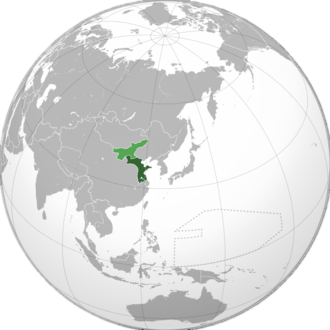
Map of the Republic of China that was controlled by the reorganized national government in 1939 (dark green) Mengjiang was incorporated in 1940 (low-cal greenish)
In theory, the Reorganized National Regime controlled all of People's republic of china with the exception of Manchukuo, which it recognized equally an contained land. In actuality, at the time of its germination, the Reorganized Government controlled only Jiangsu, Anhui, and the northward sector of Zhejiang, all being Japanese-controlled territories after 1937.
Thereafter, the Reorganized Government'southward actual borders waxed and waned as the Japanese gained or lost territory during the course of the war. During the December 1941 Japanese offensive the Reorganized Government extended its control over Hunan, Hubei, and parts of Jiangxi provinces. The port of Shanghai and the cities of Hankou and Wuchang were likewise placed under control of the Reformed Government subsequently 1940.
The Japanese-controlled provinces of Shandong and Hebei were de jure role of this political entity, though they were de facto under war machine assistants of the Japanese Northern China Surface area Regular army from its headquarters in Beijing. Likewise, the Japanese-controlled territories in cardinal Mainland china were under military administration of the Japanese Sixth Area Ground forces from its headquarters in Hankou (Wuhan). Other Japanese-controlled territories had armed forces administrations straight reporting to the Japanese military headquarters in Nanjing, with the exception of Guangdong and Guangxi which briefly had its headquarters in Canton. The central and southern zones of armed forces occupation were eventually linked together subsequently Operation Ichi-Get in 1944, though the Japanese garrison had no constructive control over most of this region autonomously from a narrow strip around the Guangzhou–Hankou railway.
The Reorganized Government'southward control was by and large limited to:
- Jiangsu: 41,818 sq mi (108,310 km2); capital: Zhenjiang (also included the national majuscule of Nanking (Nanjing))
- Anhui: 51,888 sq mi (134,390 km2); capital: Anqing
- Zhejiang: 39,780 sq mi (103,000 km2); capital: Hangzhou
According to other sources, full extension of territory during 1940 menstruation was 1,264,000 km2.
In 1940 an understanding was signed between the Inner Mongolian boob country of Mengjiang and the Nanjing regime, incorporating the quondam into the latter as an democratic part.[viii]
History [edit]
Shanghai every bit de facto capital, 1939–1941 [edit]
With Nanjing still rebuilding itself after the devastating assault and occupation past the Japanese Regal Regular army, the fledgling Reorganized Nationalist Regime turned to Shanghai as its primary focal point. With its key role as both an economic and media center for all Communist china, shut affiliation to Western Imperial powers fifty-fifty despite the Japanese invasion, and relatively sheltered position from attacks by KMT and Communist forces alike, Shanghai offered both sanctuary and opportunity for Wang and his allies' ambitions.[9] One time in Shanghai, the new regime quickly moved to have control over those publications already supportive of Wang and his peace platform, while also engaging in vehement, gang-style attacks against rival news outlets. Past November 1940, the Reorganized Nationalist Party had secured enough local support to begin hostile takeovers of both Chinese courts and banks nevertheless under nominal command past the KMT in Chongqing or Western powers. Buoyed by this rapid influx of seized collateral, the Reorganized Government under its recently appoint Finance Government minister, Zhou Fohai, was able to event a new currency for circulation. Ultimately however, the already limited economic influence garnered by the new banknotes was further diminished past Japanese efforts to incorporate the influence of the new regime, at least for a fourth dimension, to territories firmly under Japanese control similar Shanghai and other isolated regions of the Yangtze Valley.[nine]
Foundation of the Reorganized Government in Nanjing [edit]

Wall bearing a government slogan that proclaims: "Support Mr. Wang Jingwei!"

H2o Resource Commission of Wang Jingwei'south puppet government
The administrative structure of the Reorganized National Government included a Legislative Yuan and an Executive Yuan. Both were under the president and head of land Wang Jingwei. Still, bodily political power remained with the commander of the Japanese Key Cathay Surface area Ground forces and Japanese political entities formed past Japanese political advisors.
After obtaining Japanese approval to found a national regime in the summer of 1940, Wang Jingwei ordered the 6th National Congress of the Kuomintang to establish this authorities in Nanjing. The dedication occurred in the Briefing Hall, and both the "blue-sky white-sun red-globe" national flag and the "blue-sky white-sun" Kuomintang flag were unveiled, flanking a large portrait of Sun Yat-sen.
On the day the new government was formed, and only earlier the session of the "Cardinal Political Briefing" began, Wang visited Sun's tomb in Nanjing's Majestic Mount to institute the legitimacy of his power as Lord's day'southward successor. Wang had been a loftier-level official of the Kuomintang authorities and, as a confidant to Sun, had transcribed Sun's last volition, the Zongli'south Testament. To discredit the legitimacy of the Chongqing government, Wang adopted Lord's day'south flag in the hope that it would establish him as the rightful successor to Sun and bring the government back to Nanjing.
A principal goal of the new regime was to portray itself as the legitimate continuation of the former Nationalist government, despite the Japanese occupation. To this end, the Reorganized government frequently sought to revitalize and aggrandize the sometime policies of the Nationalist government, often to mixed success.[10]
Efforts to aggrandize Japanese recognition [edit]

Advertising of congratulation towards the institution of the new Nationalist government on Taiwan Nichi Nichi Shimpō
While Wang had been successful in securing from Japan a "bones treaty" recognizing the foundation of his new party in November 1940, the produced document granted the Reorganized Nationalist Authorities virtually no powers any. This initial treaty precluded whatever possibility for Wang to act as intermediary with Chiang Kai-shek and his forces in securing a peace agreement in China. Likewise, the authorities was afforded no extra authoritative powers in occupied People's republic of china, save those few previously carved out in Shanghai. Indeed, official Japanese correspondence regarded the Nanjing regime equally trivially important, and urged whatever and all token representatives stationed with Wang and his allies to dismiss all diplomatic efforts past the new government which could non directly contribute to a total military victory over Chiang and his forces.[11] Hoping to expand the treaty in such a manner as to be useful, Wang formally traveled to Tokyo in June 1941 in social club to meet with prime minister Fumimaro Konoe and his chiffonier to discuss new terms and agreements. Unfortunately for Wang, his visit coincided with the Nazi invasion of the Soviet Spousal relationship, a move which further emboldened officials in Tokyo to pursue total victory in Communist china, rather than accept a peace deal. In the finish, Konoe eventually agreed to provide a substantial loan to the Nanjing government too every bit increased sovereignty; neither of which came to fruition, and indeed, neither of which were even mentioned to military commanders stationed in Mainland china. As a slight conciliation, Wang was successful in persuading the Japanese to secure official recognition for the Nanjing Government from the other Axis Powers.[xi]
Quantum, 1943 [edit]

Wang Jingwei at a military parade
As the Japanese offensive stalled effectually the Pacific, weather condition remained generally consistent nether Wang Jingwei's government. The government continued to correspond itself every bit the legitimate regime of People's republic of china, continued to appeal to Chiang Kai-shek to seek a peace deal, and continued to abrasion under the extremely limited sovereignty afforded by the Japanese occupiers. Yet past 1943, Japanese leaders including Hideki Tojo, recognizing that the tide of war was turning against them, sought new ways to reinforce the thinly stretched Japanese forces. To this end, Tokyo finally found it expedient to fully recognize Wang Jingwei'due south government as a total ally, and a replacement Pact of Alliance was drafted for the basic treaty. This new understanding granted the Nanjing government markedly enhanced administrative control over its own territory, also every bit increased ability to brand express self-decisions. Despite this windfall, the bargain came far too late for the Reorganized authorities to have sufficient resources to take advantage of its new powers, and Japan was in no condition to offer assist to its new partner.[12]
War on Opium [edit]
Equally a result of general chaos and wartime various profiteering efforts of the conquering Japanese armies, already considerable illegal opium smuggling operations expanded greatly in the Reorganized Nation Authorities's territory. Indeed, Japanese forces themselves became arguably the largest and most widespread traffickers within the territory nether the auspices of semi-official narcotics monopolies.[10] While initially too politically weak to brand inroads into the Japanese operations, as the state of war began to turn against them, the Japanese government sought to incorporate some collaborationist governments more than actively into the war endeavour. To this end in October 1943 the Japanese government signed a treaty with the Reorganized Nationalist Authorities of China offering them a greater degree of control over their own territory.[xiii] As a result, Wang Jingwei and his government were able to gain some increased command over the opium monopolies. Negotiations by Chen Gongbo were successful in reaching an agreement to cut opium imports from Mongolia in half, besides as an official turnover of land-sponsored monopolies from Japan over to the Reorganized Nationalist Government.[fourteen] Yet, perhaps due to financial concerns, the regime sought simply express reductions in the distribution of opium throughout the remainder of the war.
The Nanjing Government and the northern Chinese areas [edit]

Expanse of command of the invading Japanese forces
The Beijing administration (East Yi Anti-Communist Autonomous Administration) was under the commander-in-main of the Japanese Northern Mainland china Expanse Army until the Xanthous River area fell within the sphere of influence of the Japanese Central China Area Army. During this same period the area from centre Zhejiang to Guangdong was administered past the Japanese North Prc Area Army. These small, largely independent fiefdoms had local money and local leaders, and frequently squabbled.
Wang Jingwei traveled to Tokyo in 1941 for meetings. In Tokyo the Reorganized National Government Vice President Zhou Fohai commented to the Asahi Shimbun newspaper that the Japanese institution was making niggling progress in the Nanjing area. This quote provoked acrimony from Kumataro Honda, the Japanese administrator in Nanjing. Zhou Fohai petitioned for total control of China's central provinces by the Reorganized National Government. In response, Royal Japanese Army Lt. Gen. Teiichi Suzuki was ordered to provide war machine guidance to the Reorganized National Government, and and then became part of the real power that lay behind Wang's rule.
With the permission of the Japanese Regular army, a monopolistic economical policy was practical, to the benefit of Japanese zaibatsu and local representatives. Though these companies were supposedly treated the same equally local Chinese companies past the regime, the president of the Yuan legislature in Nanjing, Chen Gongbo, complained that this was untrue to the Kaizō Japanese review. The Reorganized National Government of the Democracy of China too featured its own diplomatic mission in Yokohama, Japan (as did Manchukuo).
Government and politics [edit]
International recognition and foreign relations [edit]
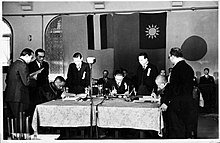
Wang Jingwei, Japanese administrator Abe Nobuyuki, and Manchukuo ambassador Zang Shiyi sign the articulation declaration, thirty November 1940
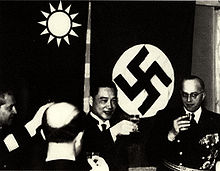

Unused case of a Wang Jingwei authorities passport, circa 1941
The Nanjing Nationalist Government received lilliputian international recognition as information technology was seen as a Japanese puppet land, being recognized merely by Japan and the rest of the Centrality powers. Initially, its main sponsor, Nippon, hoped to come to a peace accordance with Chiang Kai-shek and held off official diplomatic recognition for the Wang Jingwei regime for eight months after its founding, not establishing formal diplomatic relations with the National Reorganized Authorities until 30 Nov 1940.[15] The Sino-Japanese Basic Treaty was signed on xx November 1940, by which Japan recognised the Nationalist Government,[sixteen] and it also included a Japan–Manchukuo–China joint annunciation by which China recognized the Empire of Dandy Manchuria and the three countries pledged to create a "New Order in East asia."[17] [18] [19] The United States and Great britain immediately denounced the formation of the authorities, seeing it as a tool of Japanese imperialism.[16] In July 1941, later negotiations by Foreign Government minister Chu Minyi, the Nanjing Government was recognized every bit the government of Red china by Germany and Italy. Soon later, Espana, Slovakia, Romania, Bulgaria, Croatia, and Denmark also recognized and established relations with the Wang Jingwei regime as the government of China.[twenty] [21] [22] China under the Reorganized National Authorities also became a signatory of the Anti-Comintern Pact on 25 November 1941.[23] : 671–672
Later Japan established diplomatic relations with state of the vatican city in 1942, they and their ally Italy pressured Pope Pius XII to recognize the Nanjing regime and allow a Chinese envoy to be appointed to the Vatican, but he refused to give in to these pressures. Instead the Vatican came to an informal agreement with Japan that their apostolic delegate in Beijing would pay visits to Catholics in the Nanjing government's territory.[24] The Pope as well ignored the proposition of the aforementioned churchly delegate, Mario Zanin, who recommended in October 1941 that the Vatican recognize the Wang Jingwei regime equally the legitimate authorities of China. Zanin would remain in the Wang Jingwei regime'southward territory as churchly delegate while another bishop in Chongqing was to correspond Catholic interests in Chiang Kai-shek's territory.[25] Vichy France, despite beingness aligned with the Axis, resisted Japanese force per unit area and besides refused to recognize the Wang Jingwei authorities, with French diplomats in Cathay remaining accredited to the regime of Chiang Kai-shek.[26]
The Reorganized National Authorities had its ain Foreign Section or Ministry of Foreign Affairs for managing international relations, although it was short on personnel.[27]
On nine January 1943, the Reorganized National Government signed the "Treaty on Returning Leased Territories and Repealing Extraterritoriality Rights" with Japan, which abolished all foreign concessions inside occupied Prc. Reportedly the engagement was originally to have been later that month, simply was moved to Jan 9 to exist before the United States concluded a similar treaty with Chiang Kai-shek'south regime. The Nanjing Authorities and then took control of all of the international concessions in Shanghai and its other territories.[28] Later that year Wang Jingwei attended the Greater East Asia Conference every bit the Chinese representative.
The Wang Jingwei regime sent Chinese athletes, including the national football game team, to compete in the 1940 East Asian Games, which were held in Tokyo for the 2,600th anniversary of the legendary founding of the Japanese Empire past Emperor Jimmu, and were a replacement for the cancelled 1940 Summertime Olympics. [29]
State ideology [edit]
After Nippon's pivot towards joining the Axis powers (which included signing the Tripartite Pact), Wang Jingwei's regime promoted the idea of pan-Asianism directed confronting the West, aimed at establishing a "New Social club in East Asia" together with Japan, Manchukuo, and other Asian nations that would expel Western colonial powers from Asia, peculiarly the "Anglo-Saxons" (the U.S. and Britain) that dominated large parts of Asia. Wang Jingwei used pan-Asianism, basing his views on Sun Yat-sen's advocacy for Asian people to unite against the West in the early on 20th century, partly to justify his efforts at working together with Japan. He claimed it was natural for Japan and China to accept good relations and cooperation because of their close affinity, describing their conflicts as a temporary aberration in both nation's history. Furthermore, the authorities believed in the unity of all Asian nations with Japan equally their leader as the only way to achieve their goals of removing Western colonial powers from Asia. In that location was no official description of which Asian peoples were considered to be included in this, but Wang, members of the Propaganda Ministry, and other officials of his government writing for collaborationist media had different interpretations, at times listing Japan, Communist china, Manchukuo, Thailand, the Philippines, Burma, Nepal, India, Afghanistan, Iran, Republic of iraq, Syria, and Arabia as potential members of an "East Asian League."[31]
From 1940 onwards, the Wang Jingwei government depicted World War 2 every bit a struggle past Asians against the Due west, more specifically the Anglo-American powers. The Reorganized National Government had a Propaganda Ministry building, which exerted control over local media outlets and used them to disseminate pan-Asianist and anti-Western propaganda. British and American diplomats in Shanghai and Nanjing noted by 1940 that the Wang Jingwei-controlled press was publishing anti-Western content. These campaigns were aided by the Japanese government in China and also reflected pan-Asian thought as promoted past Japanese thinkers, which intensified afterward the start of the Pacific War in December 1941. Pro-government newspapers and journals published articles which cited instances of racial discrimination towards immigrant Asian communities living in the Westward and Western colonies in Asia. Chu Minyi, the minister of foreign affairs of the Nanjing Government, asserted in an article written before long after the attack on Pearl Harbor that the Sino-Japanese conflict and other wars among Asians were the event of surreptitious manipulation past the Western powers. Lin Baisheng, the minister of propaganda from 1940 to 1944, too made these claims in several of his speeches.[32]
Since Japan was aligned with Frg, Italy, and other European Axis countries, the Nanjing Authorities's propaganda did not portray the disharmonize every bit a state of war against all white people and focused on the U.South. and United kingdom of great britain and northern ireland in particular. Their newspapers like Republican Daily praised the High german people as a smashing race for their technological and organizational advancements and glorified the Nazi regime for supposedly transforming Germany into a great power over the by decade. The publications of the Nanjing Government too agreed with the anti-Jewish views held past Nazi Federal republic of germany, with Wang Jingwei and other officials seeing Jews as dominating the American regime and being conspirators with the Anglo-American powers to control the world.[33]
The government also took measures to ban the spread of Anglo-American culture and lifestyle among Chinese people in its territory and promoted traditional Confucian civilization. By and large information technology considered Eastern spiritual culture to be superior to the Western culture of materialism, individualism, and liberalism. Christian missionary schools and missionary activities were banned, the study of English language in schools was reduced, and the usage of English in the postal and community system was gradually reduced likewise. Vice minister of education Tai Yingfu called for a campaign against the Anglo-American nations in didactics. Zhou Huaren, vice minister of propaganda, blamed Chinese students that studied in the Westward for spreading Western values among the population and disparaging traditional Chinese culture. Wang Jingwei blamed communism, riot, and internationalism (which Wang considered Anglo-American thinking) for making other peoples despise their own civilization and embracing the Anglo-American culture. He believed it was necessary to promote Confucianism to oppose Anglo-American "cultural assailment." At the same time, Zhou Huaren and others likewise thought that it was necessary to adopt Western scientific advancements while combining them with traditional Eastern civilization to develop themselves, as he said Japan did in the Meiji Restoration, seeing that as a model for others to follow.[34]
National defense [edit]

President Wang Jingwei at a armed services parade on the occasion of the third anniversary of the institution of the government
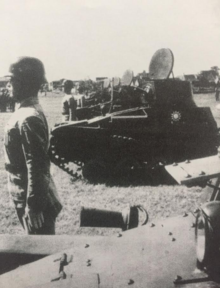
Blazon 94 tankettes on parade (notation the driver's Stahlhelm and the KMT blue and white sun keepsake on the tanks)
During its existence, the Reorganized National Government nominally led a big army that was estimated to take included 300,000 to 500,000 men, forth with a smaller navy and air force. Although its land forces possessed limited armor and artillery, they were primarily an infantry forcefulness. Armed forces aid from Japan was besides very limited despite Japanese promises to assist the Nanjing authorities in the "Japan–China Armed services Affairs Agreement" that they signed. All military matters were the responsibleness of the Fundamental Military Commission, but in practise that body was mainly a ceremonial one. In reality, many of the ground forces's commanders operated exterior of the straight command of the central government in Nanjing. The majority of its officers were either former National Revolutionary Regular army personnel or warlord officers from the early Republican era. Thus their reliability and combat adequacy was questionable, and Wang Jingwei was estimated to only be able to count on the loyalty of nearly 10% to xv% of his nominal forces. Among the reorganized government's best units were three Capital Guards divisions based in Nanjing, Zhou Fohai's Tax Police Corps, and the 1st Front Army of Ren Yuandao.[35] [36]
The majority of the government's forces were armed with a mix of captured Nationalist weaponry and a pocket-sized amount of Japanese equipment, the latter mainly being given to Nanjing's best units. The lack of local military industry for the duration of the war meant that the Nanjing regime had problem arming its troops. While the army was mainly an infantry force, in 1941 it did receive 18 Type 94 tankettes for a token armored force, and reportedly they as well received 20 armored cars and 24 motorcycles. The master type of artillery in use were medium mortars, but they also possessed 31 field guns (which included Model 1917 mountain guns)—mainly used by the Guards divisions. Oftentimes, the troops were equipped with the German Stahlhelm, which were used in large quantities past the Chinese Nationalist Ground forces. For small arms, there was no standard rifle and a large variety of unlike weapons were used, which fabricated supplying them with ammunition hard. The most common rifles in use was the Chinese version of the Mauser 98k and the Hanyang 88, while other notable weapons included Chinese copies of the Czechoslovakian ZB-26 auto guns.[36] [37]
Along with the slap-up variation in equipment, at that place was too a disparity in sizes of units. Some "armies" had only a few thousand troops while some "divisions" several grand. There was a standard bounded structure, but merely the elite Guards divisions closer to the capital letter really had anything resembling information technology. In addition to these regular army forces, in that location were multiple police and local militia, which numbered in the tens of thousands, but were deemed to be completely unreliable past the Japanese.[38] Most of the units located around Beijing in northern Mainland china remained, in effect, nether the authority of the North China Political Council rather than that of the primal government. In an attempt to improve the quality of the officeholder corps, multiple military academies had been opened, including a Fundamental War machine Academy in Nanjing and a Naval University in Shanghai. In addition there was a military university in Beijing for the N China Political Quango'due south forces, and a branch of the cardinal academy in County.[39]
A modest navy was established with naval bases at Weihaiwei and Qingdao, simply it mostly consisted of small patrol boats that were used for coastal and river defence. Reportedly, the captured Nationalist cruisers Ning Hai and Ping Hai were handed over to the government by the Japanese, becoming of import propaganda tools. Even so, the Purple Japanese Navy took them back in 1943 for its own employ. In addition at that place were 2 regiments of marines, ane at Canton and the other at Weihaiwei. By 1944, the navy was under direct control of Ren Yuandao, the naval minister.[xl] An Air Force of the Reorganized National Government was established in May 1941 with the opening of the Aviation School and receiving three aircraft, Tachikawa Ki-9 trainers. In the future the air forcefulness received additional Ki-9 and Ki-55 trainers as well equally multiple transports. Plans past Wang Jingwei to form a fighter squadron with Nakajima Ki-27s did not come to fruition equally the Japanese did not trust the pilots enough to give them combat aircraft. Morale was depression and a number of defections took identify. The but ii offensive aircraft they did possess were Tupolev SB bombers which were flown by defecting Nationalist crews.[41]
The Reorganized National Government's army was primarily tasked with garrison and law duties in the occupied territories. It besides took part in anti-partisan operations against Communist guerrillas, such equally in the Hundred Regiments Offensive, or played supporting roles for the Majestic Japanese Army (IJA).[42] The Nanjing Government undertook a "rural pacification" campaign to eradicate communists from the countryside, absorbing and executing many people suspected of being communists, with support from the Japanese.[43]
Japanese methods of recruiting [edit]
During the conflicts in primal Mainland china, the Japanese utilized several methods to recruit Chinese volunteers. Japanese sympathisers including Nanjing'south pro-Japanese governor, or major local landowners such as Ni Daolang, were used to recruit local peasants in render for coin or food. The Japanese recruited 5,000 volunteers in the Anhui area for the Reorganized National Regime Ground forces. Japanese forces and the Reorganized National Government used slogans like "Lay down your guns and take upward the plough", "Oppose the Communist Bandits" or "Oppose Corrupt Government and Back up the Reformed Authorities" to dissuade guerrilla attacks and buttress its support.[44]
The Japanese used diverse methods for subjugating the local populace. Initially, fear was used to maintain order, simply this approach was contradistinct post-obit appraisals by Japanese military ideologists. In 1939, the Japanese army attempted some populist policies, including:
- land reform by dividing the property of major landowners into minor holdings, and allocating them to local peasants;
- providing the Chinese with medical services, including vaccination against cholera, typhus, and varicella, and treatments for other diseases;
- ordering Japanese soldiers not to violate women or laws;
- dropping leaflets from aeroplanes, offering rewards for information (with parlays ready by use of a white give up flag), the handing over of weapons or other actions benign to the Japanese cause. Money and food were oftentimes incentives used; and
- dispersal of candy, food and toys to children
Buddhist leaders inside the occupied Chinese territories ("Shao-Kung") were also forced to requite public speeches and persuade people of the virtues of a Chinese alliance with Japan, including advocating the breaking-off of all relations with Western powers and ideas.
In 1938, a manifesto was launched in Shanghai, reminding the populace the Japanese alliance's track-record in maintaining "moral supremacy" as compared to the often fractious nature of the previous Republican control, and also accusing Generalissimo Chiang Kai-Shek of treason for maintaining the Western alliance.
In back up of such efforts, in 1941 Wang Jingwei proposed the Qingxiang Plan to be applied along the lower course of the Yangtze River. A Qingxiang Plan Committee (Qingxiang Weiyuan-hui) was formed with himself as Chairman, and Zhou Fohai and Chen Gongbo (every bit outset and second vice-chairmen respectively). Li Shiqun was made the committee'southward secretary. Outset in July 1941, Wang maintained that any areas to which the plan was applied would convert into "model areas of peace, anti-communism, and rebuilders of the state" (heping fangong jianguo mofanqu). It was not a success.
Economy [edit]
The North Red china Transportation Company and the Fundamental China Railway were established by the quondam Provisional Government and Reformed Government, which had nationalised individual railway and double-decker companies that operated in their territories, and continued to office providing railway and passenger vehicle services in the Nanjing authorities's territory.
Life nether the government [edit]
Japanese under the regime had greater access to coveted wartime luxuries, and the Japanese enjoyed things like matches, rice, tea, coffee, cigars, foods, and alcoholic drinks, all of which were deficient in Japan proper, but consumer goods became more scarce after Japan entered Globe War 2. In Japanese-occupied Chinese territories the prices of basic necessities rose essentially as Nihon's war effort expanded. In Shanghai in 1941, they increased elevenfold.
Daily life was oft hard in the Nanjing Nationalist Government-controlled Democracy of China, and grew increasingly and so as the state of war turned against Japan (c. 1943). Local residents resorted to the black market in society to obtain needed items or to influence the ruling establishment. The Kempeitai (Japanese Military Constabulary Corps), Tokubetsu Kōtō Keisatsu (Special Higher Police), collaborationist Chinese police, and Chinese citizens in the service of the Japanese all worked to conscience data, monitor whatsoever opposition, and torture enemies and dissenters. A "native" undercover agency, the Tewu, was created with the aid of Japanese Army "advisors". The Japanese also established prisoner-of-war detention centres, concentration camps, and kamikaze training centres to indoctrinate pilots.
Since Wang'southward government held authorization merely over territories under Japanese military occupation, there was a express amount that officials loyal to Wang could do to ease the suffering of Chinese under Japanese occupation. Wang himself became a focal point of anti-Japanese resistance. He was demonised and branded equally an "arch-traitor" in both KMT and Communist rhetoric. Wang and his government were deeply unpopular with the Chinese populace, who regarded them as traitors to both the Chinese state and Han Chinese identity.[45] Wang'southward rule was constantly undermined by resistance and demolition.
The strategy of the local education system was to create a workforce suited for employment in factories and mines, and for manual labor. The Japanese also attempted to introduce their civilization and dress to the Chinese. Complaints and agitation chosen for more than meaningful Chinese educational development. Shinto temples and similar cultural centers were built in order to instill Japanese culture and values. These activities came to a halt at the end of the war.
Notable figures [edit]
Local assistants:
- Wang Jingwei: President and Head of State
- Chen Gongbo: President and Caput of State after the death of Wang. Also, President of the Legislative Yuan (1940–1944) and Mayor of the Shanghai occupied sector.
- Zhou Fohai: Vice President and Finance Minister in the Executive Yuan
- Wen Tsungyao: Chief of the Judicial Yuan
- Wang Kemin: Internal Diplomacy Minister, previously head of the Provisional Government of the Republic of China
- Liang Hongzhi: Head of the Legislative Yuan (1944–1945), previously head of the Reformed Government
- Yin Ju-keng: Member of the Legal Affairs Department, previously head of the E Hebei Democratic Regime
- Wang Yitang: Minister of the Examination Yuan, Chairman of the North China Political Quango (1940–1943)
- Jiang Kanghu: Principal of the Pedagogy Yuan
- Xia Qifeng: Chief of the Auditing Bureau of the Control Yuan
- Ren Yuandao: Government minister of the Navy (1940–1945) & Chairman of the National Military Council (1940–1942)
- Xiao Shuxuan: Government minister of Military Affairs (1945) & Chairman of the National Military Council (1942–1945)
- Yang Kuiyi: Chief of General Staff (1940–1942) & Chairman of the National Military Quango (1945)
- Bao Wenyue: Minister of Military Affairs (1940–1943) & Chief of Full general Staff (1943–1945)
- Ye Peng: Minister of Military Diplomacy (1943–1945) & Chief of General Staff (1942)
- Xiang Zhizhuang: Commander of the 5th Group Regular army, Commander of the 12th Army, Governor and Commander of Security in Zhejiang Province, Governor of Jiangsu Province
- Rong Zhen: Principal of the Commission for Subjugation Communists, Governor of Hebei Province (1945)
- Kou Yingjie: Councilor of the General Staff office
- Liu Yufen: Main of General Staff (1942–1943)
- Hu Yukun: Chief of General Staff (1945)
- Hao Pengju: Chief of Staff of the 1st Regular army group, Governor of Huaihai, Full general commander of the sixth Route Army
- Wu Huawen: Commander in Chief of the 3rd Front end Army
- Qi Xieyuan: Commander-in-Master of the North China Appeasement army, Supervisor of the Full general assistants of Justice
- Sun Dianying: Commander of the Collaborationist Chinese Army 6th group army commune
- Ding Mocun: Chief of the Collaborationist Clandestine police, Minister of Society, Minister of Send, Governor of Zhejiang province
- Li Shiqun: Head of No. 76, the regime'due south hugger-mugger service stationed in No. 76 Jessefield Route in Shanghai
- Zhu Xingyuan: Chief of the Agency of Political Affairs
- Tang Erho: Chairman of the North China Political Affairs Commission
- Gu Zhongchen: Vice-Chief of the Test Yuan (1940–1944), Master of the Examination Yuan (1944–1945)
- Thung Liang Lee: director of the International Publicity Bureau (1940–1945)
- Xia Suchu: Executive Vice-main to the Evaluation Department of the Examination Yuan, Principal Secretary of the Test Yuan
- Chen Qun: Interior Minister (1940–1943)
- Luo Junqiang: Government minister of Justice (1942–1943), Governor of Anhui (1943–1944)
- Zhao Yusong: Government minister of Agriculture (1940–1941), Minister of Justice (1941–1942), Minister of Ceremonious Service (1942–1943)
- Mei Siping: Interior Government minister (1943–1945)
- Su Tiren: Governor of Shanxi (1938–1943), Mayor of Beijing Special city (1943)
- Zhao Zhengping: Government minister of Education (1940–1941)
- Wang Shijing: Executive Member and Governor to the General Function for Finance, Governor of the General Function for Economic system
- Zhou Huaren: Executive Vice-Minister of Railways, Mayor of Guangzhou Special Municipality
- Lin Bosheng: Propaganda Minister (1940–1944)
- Zhao Zhuyue: Propaganda Government minister (1944–1945)
- Gao Guanwu: Mayor of Nanjing Special Metropolis (1938–1940), Governor of Jiangsu (1940–1943), Governor of Anhui (1943), Governor of Jiangxi (1943–1945)
- Chen Zemin: Governor of Jiangsu Province
- Yu Jinhe: Mayor of Beijing Special City (1938–1943)
- Lin Biao (built-in 1889): Chief of the Administrative Loftier Court
- Kaya Okinori: Japanese nationalist, merchant, and commercial adviser
- Chu Minyi: Strange Minister (1940; 1941–1945), ambassador to Nihon (1940–1941)
- Cai Pei: Mayor of Nanjing Special Urban center (1940–1942), ambassador to Nippon (1943–1945)
- Xu Liang: Foreign Government minister (1940–1941), administrator to Japan (1941–1943)
- Li Shengwu: Strange Minister (1945), ambassador to Deutschland
- Zhang Renli: Mayor of Tianjin Special City (1943)
- Yan Jiachi: Vice-Minister for Finance, Command Officer of the Control Yuan
- Xu Xiuzhi: Mayor of Beijing Special City (1945)
- Lian Yu: administrator to Manchukuo (1940–1943), ambassador to Japan (1945)
- Zhu Lühe: Vice-Chief of the Judicial Yuan, Chairperson of the Disciplinary Action committee for Central Public Servants
- Wen Shizhen: Mayor of Tianjin Special City (1939–1943)
- Wang Xugao: Governor of Jinhaidao, Mayor of Tianjin Special Urban center
- Wang Yintai: Governor of the Full general Function for Concern, Governor of the General Office for Agriculture, Chairperson of the Due north Cathay Political Quango
- Chen Jicheng: ambassador to Manchukuo (1943–1945)
- Wang Xiang (Republic of China politician): Chief of the Agency for Education in Shanxi, Governor and Security Commander of Shanxi
- He Peirong: Governor of Hubei province (1938–1942), Commander of Security in Hubei
- Ni Daolang: Governor of Anhui Province
- Wang Ruikai: Governor of Zhejiang province (1938–1941)
- Zhu Qinglai: Minister of Send, Chairman of the Irrigation Commission, Vice-Main of the Legislative Yuan
- Wu Zanzhou: Governor of Hebei province (1939–1943), President of the Police High School
- Shao Wenkai: Governor of Henan province
- Wang Mo: Chief of the General Office for Pedagogy
- Chao Kung: (Ignaz Trebitsch-Lincoln), purported Buddhist leader
- Zhou Longxiang: Diplomat, Chief Secretarial assistant of the Executive Yuan, Primary of the Civil Servants.
- Zhou Xuechang: Mayor of Nanjing Special City (1941–1945)
- Zhu Shen: Executive Member and Chief of the Agency for Political Affairs, Chairperson of the Due north Red china Political Council
- Yu Baoxuan: Observer to the Committee for Loftier Ranking Officers Test
- Li Fang (diplomat): Foreign minister to Romania and Hungary, Ambassador to Deutschland
- Yin Tong: Governor of the Full general Function for Construction
- Hao Peng (ROC): Chief Executive of the Suhuai Special Region, Commander of the Suhuai Special Region Security forces
- Wu Songgao: Secretary of the Cardinal Political Committee, Vice-Minister for Judicial Administrating, Chairman of the Committee for Baojia organization
- Yue Kaixian: Chief of the General Function for Business
- Deng Zuyu: Governor of Jiangxi province (1943)
Foreign representatives and diplomatic personnel:
- Nobuyuki Abe: Japanese ambassador to the Reorganized National Government (1940)
- Kumataro Honda: Japanese ambassador (1940–1941)
- Mamoru Shigemitsu: Japanese administrator (1941–1943)
- Masayuki Tani: Japanese administrator (1943–1945)
- Teiichi Suzuki: Japanese armed forces and political adviser
- Sadaaki Kagesa: Japanese military counselor
- Zang Shiyi: Manchukuo administrator
- Li Shaogeng: Manchukuo special envoy
- Heinrich Georg Stahmer: German ambassador (1941–1943)
- Erich Kordt: German administrator (1943)
- Ernst Woermann: German ambassador (1943–1945)
- Francesco Maria Taliani de Marchio: Italian ambassador (1941–1943)
- Álvaro de Maldonado y de Liñán: Castilian government minister (1941–1943)
- José González de Gregorio: Spanish chargé d'affaires (1944–1945)
- Hialmar Collin: Danish government minister (1941–1945)
Legacy [edit]
Having died earlier the war had concluded, Wang Jingwei was unable to join his fellow Reorganized Nationalist Regime leaders on trial for treason in the months that followed the Japanese surrender. Instead he, aslope his presidential successor Chen Gongbo (who was tried and sentenced to death by the victorious Nationalists) and his vice president Zhou Fohai (who had his decease sentence commuted to life imprisonment), was given the championship Hanjian significant arch-traitor to the Han people. In the following decades, Wang Jingwei and the entire reputation of the collaborationist regime have undergone considerable scholastic contend. In full general, evaluations produced past scholars working nether the People'due south Commonwealth of China take held the almost critical interpretations of the failed regime, Western scholars typically holding the regime and Wang Jingwei especially in a sympathetic lite, with Taiwanese scholars falling somewhere in the middle.[46]
In popular culture [edit]
- Lust, Caution is a 1979 novella by Chinese author Eileen Chang which was later turned into an honor-winning film past Ang Lee. The story is near a group of young university students who try to assassinate the Minister of Security of the Reorganized National Government. During the war, Ms. Chang was married to Hu Lancheng, a writer who worked for the Reorganized National Government and the story is believed to be largely based on bodily events.
- The 2009 Chinese motion picture The Message is a thriller/mystery in the vein of a number of Agatha Christie novels. The main characters are all codebreakers serving in the Reorganized National Government's military, but ane of them is a Kuomintang double-agent. A Japanese intelligence officeholder detains the group in a castle and attempts to uncover which of them is the spy using psychological and concrete coercion, uncovering the protagonists' bitter rivalries, jealousies, and secrets as he does so.
- The Tv Serial Sparrow (Tv series) is a motion-picture show is a spy genre thriller. During Shanghai's Reorganised Authorities, communist amanuensis Chen Shen infiltrates the Japanese' base of operations and adopts the code name "Sparrow". His mission is to obtain the "cipher" intel, a secret plan that could destroy China. To do and then, he becomes the assistant of Bi Zhongliang, the leader of the Special Operations Team under the Public Security Bureau.
See also [edit]
- Manchukuo
- Swell Mode Government
- Second Sino-Japanese War
- History of the Republic of China
- National Revolutionary Army
- Collaborationist Chinese Regular army
- Organisation of the Cathay Garrison detachment of the Royal Japanese Army (to 1937)
- Organization of Japanese Expeditionary forces in China
- List of East Asian leaders in the Japanese sphere of influence (1931–1945)
- List of leaders of the Democracy of China
Notes [edit]
- ^ The yellow pennant, which reads Peace, Anti-Communism, National Construction, was not attached to the flag itself simply flew separately on the flagpole immediately above it. In 1943, the pennant, which was previously mandatory for outdoor use of the flag, was removed. This made the flag identical to that of the rival Nationalist government based in the wartime capital Chongqing.
References [edit]
Citations [edit]
- ^ Japanese Newsreel with the national anthem on YouTube
- ^ Bate (1941), p. 80–84.
- ^ Bate (1941), pp. 130–135.
- ^ Bate (1941), p. 136.
- ^ Bate (1941), p. 144.
- ^ Bunker (1972), pp. 149–160.
- ^ Boyle (1972), pp. 277–280.
- ^ MacKinnon & Lary (2007), p. 162.
- ^ a b Bunker (1972), pp. 252–263.
- ^ a b Martin (2003), pp. 365–410.
- ^ a b Bunker (1972), pp. 264–280.
- ^ Matos, Christine; Caprio, Marking (2015). Japan as the Occupier and the Occupied. New York, NY: Palgrave Macmillan. pp. 152–160. ISBN978-one-137-40810-5.
- ^ Martin (2003), p. 385.
- ^ Martin (2003), pp. 392–394.
- ^ Boyle (1972), p. 301.
- ^ a b Then (2011), p. 75.
- ^ So (2011), p. 77.
- ^ Signing of Nippon-Manchukuo-China Articulation Declaration.
- ^ Chinese puppet government travel certificate Archived 2017-12-22 at the Wayback Automobile. Published 23 September 2016. Retrieved 19 December 2017.
- ^ Dorn (1974), p. 243.
- ^ Cotterell (2009), p. 217. sfnp mistake: no target: CITEREFCotterell2009 (help)
- ^ Brodsgaard (2003), p. 111.
- ^ Smyth, Howard M.; et al., eds. (1970). 15. September bis eleven. Dezember 1941. Akten zur deutschen auswärtigen Politik 1918-1945 (in High german). Vol. D-13-two. Vandenhoeck + Ruprecht.
- ^ Pollard (2014), p. 329. sfnp error: no target: CITEREFPollard2014 (assistance)
- ^ The "Magic" Groundwork to Pearl Harbor, Volume four. Japanese diplomatic cables published by US Section of Defense, p. A-460.
- ^ Young (2013), pp. 250–251.
- ^ The "Magic" Background to Pearl Harbor, Volume iv. Japanese diplomatic cables published past U.s. Department of Defense, pp. A-456–A-465.
- ^ Wang (2016), pp. 31–32.
- ^ Collins, Sandra (2014). 1940 TOKYO GAMES – COLLINS: Japan, the Asian Olympics and the Olympic Movement. Routledge. pp. 179–180. ISBN978-1317999669.
- ^ And then (2011), p. 78–80.
- ^ So (2011), pp. 81–83.
- ^ And so (2011), pp. 86–88.
- ^ So (2011), pp. 89–92.
- ^ Barret (2002), pp. 109–111
- ^ a b Jowett (2004), pp. 65–67
- ^ Jowett (2004), pp. 75–77
- ^ Jowett (2004), pp. 71–72
- ^ Jowett (2004), pp. 77–78
- ^ Jowett (2004), pp. 103–104
- ^ Jowett (2004), pp. 94–96
- ^ Jowett (2004), pp. 80–82
- ^ Zanasi (2008), p. 747.
- ^ Smedley (1943), p. 223.
- ^ Frederic Wakeman, Jr. "Hanjian (Traitor) Collaboration and Retribution in Wartime Shanghai." In Wen-hsin Yeh, ed. Becoming Chinese: Passages to Modernity and Across. (Berkeley: University of California Printing, 2000), 322.
- ^ Chen, Jian-yue (2004). "American studies of Wang Jingwei:defining Nationalism". World History Review.
Sources [edit]
- Journal articles
- Martin, Brian G. (2003-01-01). "'in My Centre I Opposed Opium': Opium and The Politics of the Wang Jingwei Government, 1940–45". European Journal of East Asian Studies. 2 (two): 365–410. doi:10.1163/157006103771378464. JSTOR 23615144.
- So, Wai Chor (Jan 2011). "Race, Civilisation, and the Anglo-American Powers: The Views of Chinese Collaborators". Modern China. 37 (1): 69–103. doi:10.1177/0097700410382542. JSTOR 25759539.
- Zanasi, Margherita (June 2008). "Globalizing Hanjian: The Suzhou Trials and the Post-World War Two Soapbox on Collaboration". The American Historical Review. 113 (iii): 731–751. doi:x.1086/ahr.113.3.731. JSTOR 30223050.
- Books
- Bate, Don (1941). Wang Ching Wei: Puppet or Patriot. Chicago, IL: RF Seymour.
- Barrett, David P.; Shyu, Larry N., eds. (2001). Chinese Collaboration with Japan, 1932–1945: The Limits of Accommodation. Stanford Academy Printing.
- Behr, Edward (1987). The Last Emperor. Recorded Picture Co. (Productions) Ltd and Screenframe Ltd.
- Boyle, John H. (1972). People's republic of china and Japan at War, 1937–1945: The Politics of Collaboration. Harvard University Press.
- Brodsgaard, Kjeld Erik (2003). China and Denmark: Relations since 1674. Nordic Establish of Asian Studies.
- Bunker, Gerald (1972). The Peace Conspiracy: Wang Ching-wei and the China War, 1937–1941. Cambridge, Massachusetts: Harvard University Press. ISBN978-0674-65915-5.
- Ch'i, Hsi-sheng (1982). Nationalist Communist china at War: Military machine Defeats and Political Plummet, 1937–1945. Ann Arbor, MI: University of Michigan Press.
- Chiang, Kai-Shek. The Soviet Russian federation in Prc.
- Chiang, Wego W. K. How the Generalissimo Chiang Kai Shek gained the Chinese-Japanese eight years war, 1937–1945.
- Cotterel, Arthur (2009). Western Power in Asia: Its Slow Ascent and Swift Fall, 1415–1999. Wiley.
- Dorn, Frank (1974). The Sino-Japanese War, 1937–41: From Marco Polo Bridge to Pearl Harbor. Macmillan.
- Hsiung, James C.; Levine, Steven I., eds. (1992). Red china's Biting Victory: The State of war with Nihon, 1937–1945. Armonk, NY: M. Due east. Sharpe.
- Jowett, Phillip Southward. (2004). Rays of The Ascent Lord's day, Military machine of Japan's Asian Allies 1931–45, Volume I: China & Manchuria. Solihull, West Midlands, England: Helion & Co. Ltd.
- MacKinnon, Stephen; Lary, Diana (2007). China at War: Regions of China, 1937–1945. Stanford Academy Press.
- Max, Alphonse (1985). Southeast Asia Destiny and Realities. Establish of International Studies.
- Mote, Frederick West. (1954). Japanese-Sponsored Governments in China, 1937–1945. Stanford University Press.
- Newman, Joseph (March 1942). Goodbye Japan. New York, NY.
- Pollard, John (1014). The Papacy in the Age of Totalitarianism, 1914–1958 . Oxford University Press. ISBN0199208565.
- Smedley, Agnes (1943). Battle Hymn of China.
- Wang, Wei (2016). Red china'southward Cyberbanking Law and the National Treatment of Strange-Funded Banks. Routledge.
- Young, Ernest (2013). Ecclesiastical Colony: Cathay'southward Cosmic Church and the French Religious Protectorate. Oxford University Press. pp. 250–251. ISBN978-0199924622.
External links [edit]
- Central China Railway Visitor Flag, under Japanese Army control
- Flags of the Reorganized National Regime of the Republic of Red china
- Slogans, Symbols, and Legitimacy: The Case of Wang Jingwei'southward Nanjing Regime
- Visual cultures of occupation in wartime Mainland china
Coordinates: 32°03′N 118°46′Eastward / 32.050°Northward 118.767°E / 32.050; 118.767
Source: https://en.wikipedia.org/wiki/Wang_Jingwei_regime
Posted by: woodardshrothem.blogspot.com
0 Response to "Chinese City of Wuhan Reports Cholera Case, Communist Youth League Tries Blaming US"
Post a Comment